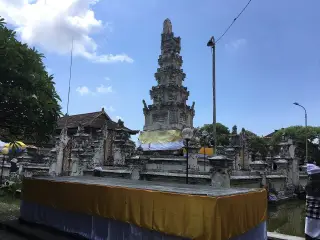

Singaraja Heritage Plan Advances with Zero-Kilometre Upgrade
Regent I Nyoman Sutjidra is tying funded upgrades at Singaraja’s zero-kilometre point to a wider effort to reinforce the city’s status as a heritage centre, but public reports detail projects in the downtown core rather than a fully mapped…
Editor: Mursyid Sonsang
· Event date: · 4 min read Updated
Singaraja — Buleleng Regent I Nyoman Sutjidra has linked ongoing physical works in central Singaraja to a broader plan to strengthen the city’s heritage identity, but available reports describe concrete projects at the city’s zero-kilometre point rather than a formally mapped reorganization of wider historic areas.
Local media in August 2025 reported Sutjidra’s commitment to preserving Singaraja as a kota pusaka, or heritage city, during the National Working Meeting of the Indonesian Heritage Cities Network (JKPI) in Yogyakarta. According to those reports, he spoke of plans to “rearrange” heritage areas around Singaraja in the near future. However, subsequent coverage in 2025 and 2026 has focused on specific projects and a master plan for the downtown heritage zone rather than a detailed, published map of all historic areas in and around the city.
Master plan and zero-kilometre project
Radio Republik Indonesia (RRI) Singaraja reported in June 2025 that the Buleleng administration was preparing a master plan for Singaraja’s heritage area, with an initial focus on the city’s zero-kilometre point. The plan includes rows of Dutch-era buildings near the regent’s office, official residence and the Laksmi Graha women’s hall.
In November 2025, Detik Bali reported that the regency government began reorganizing utility networks at the zero-kilometre area as an early step in improving the heritage corridor. The works cover sections from the Singa Ambara Raja statue past the local legislative council building towards Jalan Pahlawan and Jalan Krisna, including the heritage building known as Rumah Sunda Kecil.
Groundbreaking for the main zero-kilometre heritage project took place on 20 February 2026. According to Detik Bali and Sinartimur, the project is financed through a special financial grant from Badung Regency of about Rp 25 billion, with a contract value just over Rp 24 billion and an effective construction period of roughly 4.5 to 5 months.
Sutjidra has said the works aim to restore the appearance of the area “as it used to be”, create a more representative public space and integrate the zone into a Singaraja city tour linking puri (palace) compounds and other heritage sites.
Scope of heritage assets
Reports on the heritage plan consistently describe Singaraja’s significance as a former royal centre, colonial port and provincial capital in the early independence period. The downtown heritage corridor being upgraded includes colonial-era government buildings, the regent’s office and residence, Laksmi Graha, and the Rumah Sunda Kecil complex associated with the period when Singaraja served as the capital of Sunda Kecil (Lesser Sunda).
Other well-known heritage sites in and around Singaraja, such as the Old Buleleng Port and Museum Gedong Kertya, are frequently mentioned in tourism and cultural coverage of the city, but the current construction-focused reports do not clearly state whether these locations are formally included in the same mapped heritage zone as the zero-kilometre project.
JKPI context
The Indonesian Heritage Cities Network (JKPI) is the framework under which Sutjidra has articulated his preservation agenda, using the national network to exchange ideas on managing heritage cities. Public reports on JKPI do not provide a verified, current figure for membership matching the 75 local governments cited in the draft, and membership numbers appear to vary in different accounts over time.
Outstanding details
Across the available coverage, the regency’s direction is clear: Sutjidra wants to maintain and promote Singaraja as a heritage city and is backing that objective with a funded downtown project and a master plan for the zero-kilometre area.
What is less clear in public reports is the full extent of any mapped heritage area beyond the central corridor. Coverage focuses instead on the initial master plan, utility relocation, building restoration and integration of the zero-kilometre zone into city tour routes.
Sources
Read next
More on this story
East Indonesia Desk
Landslides block four-wheel access to Sepang Kelod in northern Bali
Heavy rain triggered three landslides in Sepang, Buleleng, on November 1, damaging homes and retaining walls and cutting four-wheel access to Sepang K…
Most read in Bali News
Related