
Kertha Gosa’s historic court hall and paintings need ongoing conservation
Kertha Gosa in Semarapura, once a royal court hall, is now a major cultural tourism site whose historic pavilion and Kamasan-style ceiling paintings are protected as cultural heritage and require ongoing conservation by local authorities…
By Mukmin John
Editor: Mursyid Sonsang
· Event date: · 4 min read Updated
Semarapura — Kertha Gosa, the historic former court pavilion in the centre of Semarapura, continues to be treated as a key cultural asset for Klungkung, but its structure and Kamasan-style ceiling paintings require ongoing conservation and careful management according to recent government and heritage accounts.
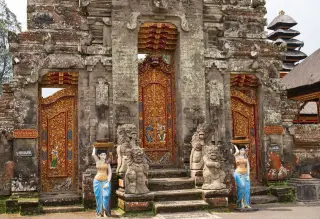
Kertha Gosa forms part of the old royal palace complex in Semarapura and historically served as a place where rulers and officials discussed problems of security, prosperity and justice for the kingdom, according to an inventory by the Bali Cultural Heritage Preservation Center and the Klungkung culture e-museum. The complex sits within Taman Gili, also known as Bale Kambang, a pavilion surrounded by a pond that is considered inseparable from the wider palace site.
An article published by the Denpasar State Property and Auction Service Office (KPKNL Denpasar) under the Ministry of Finance describes Kertha Gosa as a valuable regional cultural asset that continues to be preserved. It notes that the uniqueness of the building and its ceiling paintings has made the site both a symbol of local heritage and a cultural tourism attraction in eastern Bali.
Other studies on the site describe it as one of Klungkung’s mainstay cultural tourism attractions, underlining its role in local identity and the visitor economy.
Historic court hall with Kamasan paintings
Government and academic sources state that Kertha Gosa dates back to the period of the Klungkung kingdom, with construction linked to the establishment of the royal complex in the late 17th and 18th centuries. In the pre-colonial era it functioned as a royal court hall, a place for hearings and deliberations on customary and state matters.
The pavilion’s most distinctive feature is its ceiling, painted in the traditional Kamasan wayang style. These panels depict narrative scenes drawn from epic literature such as the Mahabharata and are widely interpreted as visualising themes of karma, justice and the consequences of human actions. Researchers have highlighted the paintings’ role as both moral education and historical record, contributing to the site’s aesthetic and cultural significance.
Ongoing conservation needs
The KPKNL Denpasar article outlines a set of preservation measures that are described as part of continuing efforts to safeguard Kertha Gosa. According to the article, physical conservation of the historic buildings is carried out periodically, restoration of the ceiling paintings is undertaken by conservation specialists and traditional artists, legal protection is provided through cultural-heritage status, and education and promotion activities are conducted via school visits and cultural festivals.
The Bali Cultural Heritage Preservation Center’s inventory identifies Kertha Gosa as a cultural-heritage site containing multiple registered heritage buildings and objects from the Klungkung royal period. Heritage commentators note that conservation of structures such as Kertha Gosa is seen as a way to maintain architectural, artistic and historical values for future generations and to provide a resource for education and research.
While the site has undergone several restoration campaigns, including work documented as recently as 2014 on the paintings and structures, sources emphasise that age, exposure to the tropical climate and visitor pressure continue to pose risks to both the building and its decorative programme. Conservation is therefore framed as an ongoing responsibility rather than a project with a defined end point.
Management and visitor experience
Kertha Gosa is described as a cultural tourism destination managed by local authorities, with one recent report noting that the complex is directly administered by the Klungkung tourism office and open daily to visitors during set hours. The broader tourism literature on the site highlights its role as a cultural-heritage attraction with high artistic and historical value, contributing to local economic activity while requiring sensitive management.
Heritage studies and government messaging encourage framing visits to Kertha Gosa as encounters with a living heritage site rather than purely a photographic stop. By combining periodic building maintenance, specialist care for the paintings, legal protection and educational programmes, authorities and cultural organisations aim to preserve the court hall’s physical fabric and moral narratives so they can continue to inform understandings of law, justice and ethics in Bali.
Sources
- DJKN Kementerian Keuangan – KPKNL Denpasar article "Kertha Gosa, Aset Berharga Daerah yang Terus Dilestarikan"
- Balai Pelestarian Cagar Budaya Bali – "Inventarisasi Situs Kerta Gosa"
- Love Bali – "Kertha Gosa dan Taman Gili" destination page
- Warmadewa University journal article (UNDAGI) on Kertha Gosa
- BudayaBali.com – "Menelusuri Warisan Sejarah dalam Balai Keadilan Kertha Gosa Klungkung"
- Klungkung E-Museum – "Kerta Gosa" page
- Detik Bali – "Mengunjungi Kerta Gosa, Peradaban Zaman Kerajaan di Klungkung"
Read next
More on this story
Travel Advisory
Bali deploys soldiers and police as fuel queues ease in parts of island
Bali authorities deployed 120 soldiers and police officers after an odd-even Pertalite rule helped ease queues in Denpasar and Badung, while lines rem…
Most read in Culture & Ceremony
Today’s top story

Related