
Tumpek Uye 2026: How Bali’s holy day honours animals
Tumpek Uye, also known as Tumpek Kandang, fell on Saturday, 5 September 2026.
By Mukmin John
Editor: Mursyid Sonsang
· Event date: · 6 min read

Denpasar — Hindu communities in Bali observed Tumpek Uye, also known as Tumpek Kandang, on Saturday, 5 September 2026, as a day to express gratitude and respect toward animals, following the Balinese Pawukon calendar date of Saniscara Kliwon Wuku Uye according to local media, the provincial customary-community agency and Uluwatu Temple.
The holy day is marked every 210 days, when Saturday (Saniscara) coincides with Kliwon in the Uye wuku, and is devoted to ceremonies for animals, particularly livestock, according to calendar explanations and cultural coverage from Balinese outlets and national lifestyle media.
Families and communities may pray for animals, bathe or clean them, prepare offerings and seek blessings, with practices varying by customary village, household circumstances and the types of animals involved.
Tumpek Uye does not mean that animals themselves are worshipped as gods.
Local coverage and religious guidance describe prayers as directed to Ida Sang Hyang Widhi Wasa through divine manifestations associated with protecting animals, and explain that the day is meant to honour animals as part of creation rather than elevate them to the level of deities.
A religious obligation toward living beings
The observance is commonly linked with the Hindu principle of Tat Twam Asi, broadly understood in Balinese practice as recognising the self in others and others in the self.
In that interpretation, showing care toward animals becomes an expression of devotion to the divine and a reminder that humans share existence with other living beings.
Tumpek Uye is also connected with Tri Hita Karana, a Balinese philosophy of harmony between humans and God, among humans themselves, and between humans and the natural environment.
Animals therefore appear in the tradition not only as property or economic resources but as part of a wider spiritual and ecological relationship.
Cultural reporting notes that animals provide food, labour, livelihoods and materials that form part of religious practice, and that Tumpek Uye is meant to cultivate gratitude and restraint in how people treat them.
Some interpretations link the "kandang" or enclosure not only to animal pens but to a symbolic effort to control unruly thoughts and behaviour.
Religious commentary cited in local media includes verses from Hindu scripture that call for the happiness of people, animals and all living beings, supporting the view that the occasion is a lesson in responsibility and compassion rather than simply a ritual date on the calendar.
The religious message, however, is not presented in these sources as proof that every modern animal-welfare standard is automatically fulfilled, and there is no single island-wide welfare code documented as being created specifically for Tumpek Uye.
Government coordination and ceremonies in 2026
The Bali Provincial Agency for the Advancement of Customary Communities (Dinas Pemajuan Masyarakat Adat) held a virtual coordination meeting on Friday, 4 September 2026, led by agency head I G.A.K. Kartika Jaya Seputra and attended by division heads responsible for customary-village development, customary law and customary-village governance.
According to the agency, the meeting aimed to strengthen cooperation and encourage customary villages and residents to respect animals as part of harmonious relations with nature, and to prepare for a coordinated and meaningful observance of Tumpek Uye across Bali.
Separate provincial and media reports state that Tumpek Uye ceremonies on 5 September 2026 were held concurrently across Bali’s regencies and municipalities, with activities ranging from collective prayers to concrete actions such as releasing animals and environmental clean-ups.
At the provincial level, one set of ceremonies was centred at Pura Luhur Batukaru in Tabanan, where officials and community leaders joined prayers focused on gratitude and harmony with nature.
In Denpasar, a city-level ceremony at Pura Agung Jagatnatha on 5 September combined Tumpek Uye prayers with practical animal-health measures, including free rabies vaccination and sterilisation services for pets offered to residents, according to local news.
These examples underline that coordination of religious and customary activities can be accompanied by modern animal-health programmes in specific locations, even if the observance itself is framed primarily in religious and cultural terms.
Uluwatu Temple and the macaques
Uluwatu Temple offers a prominent setting for discussing the relationship between ritual, wildlife and conservation.
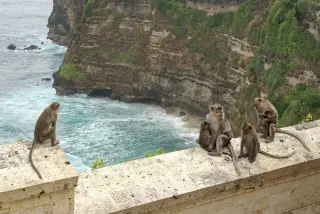
The temple’s own information describes a population of roughly several hundred long-tailed macaques living in and around the temple grounds, with another group near Labuan Sait Beach, and emphasises their role in the site’s cultural and natural landscape.
The temple’s account of a Tumpek Kandang ceremony in July 2025 explains that the event included prayers, offerings, traditional dance, community participation and the distribution of blessed fruit to the macaques.
It also illustrates a practical boundary for visitors: the temple advises people not to feed the macaques independently and states that feeding and wildlife-management practices are organised to support the animals’ health and to reduce dependence on inappropriate human food.
What the observance does—and does not—confirm
Tumpek Uye provides a religious framework for gratitude, restraint and care toward animals.
Its teachings reinforce contemporary conversations about responsible treatment of animals, environmental stewardship and the effects of human behaviour on wildlife.
Available 2026 reports show that ceremonies and practical actions took place in various parts of Bali, but they do not claim that every temple conducted identical rituals, that all animals received veterinary attention, or that uniform new welfare regulations were introduced for the whole island.
For visitors who encounter Tumpek Uye ceremonies, guidance from religious institutions and temple managers generally recommends viewing them as part of living religious and community practice rather than as performances staged solely for tourism.
Keeping a respectful distance, avoiding unnecessary noise and following temple directions are practical steps to avoid disrupting observances while still learning from this aspect of Balinese culture.
Sources
- Tribun Bali – Kalender Bali: Tumpek Kandang 5 September 2026, Simak Maknanya dan Banten yang Dipersembahkan
- Liputan6 – Kalender Bali Bulan September 2026, Panduan Hari Raya dan ...
- IDN Times Bali – Makna Tumpek Kandang, Syukurannya Hewan di Bali
- Dinas Pemajuan Masyarakat Adat Provinsi Bali – Kadis PMA Bali Pimpin Rakor Penguatan Pelaksanaan Tumpek Uye
- Bali Ekbis – Perayaan Tumpek Uye Digelar Serentak di Seluruh Bali, Perkuat Kepedulian terhadap Satwa dan Lingkungan
- RRI Denpasar – Bupati Sanjaya Ajak Masyarakat Jaga Keharmonisan dengan Alam
- Atnews – Wali Kota Jaya Negara Ngaturang Bhakti Pitenget Tumpek Uye
- Bali Post – 5 Berita Koran Bali Post Terbit Hari Ini, Senin 7 September 2026 (item: Tumpek Uye Dirayakan Serentak di Bali, Dari Vaksinasi Rabies hingga Pelepasa
- Uluwatu Temple – Tumpek Kandang 2026 at Uluwatu Temple and Its Meaning
- detikBali
Read next
More on this story

Environment
Heavy rain damages road retaining structure in Jembrana
Heavy rain triggered a landslide that damaged a retaining structure on Jalan Nakula in Yehembang Kauh on October 30, with no deaths or injuries report…
Most read in Culture & Ceremony
Today’s top story
Related