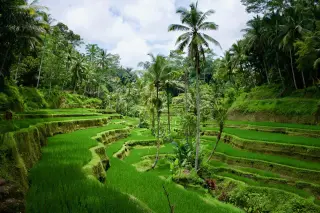

Rice field conversion intensifies pressure on Bali’s subak system
Bali’s rapid conversion of productive rice fields into housing and commercial areas is intensifying pressure on farming livelihoods, subak irrigation networks and food security, prompting new provincial controls on land use.
By Pandi Muktar
Editor: Mursyid Sonsang
· Event date: · 5 min read
Denpasar — Rapid conversion of Bali’s productive rice fields into housing and commercial properties is intensifying pressure on farming livelihoods and the island’s subak irrigation system, according to religious leaders, local officials and research on land-use change in Bali.
Concerns about the pace and impact of land conversion were highlighted in a recent broadcast of the Rahajeng Bali program, where Hindu religious counselor I Gusti Putu Suana warned that selling productive farmland for short-term gain undermines ecological functions, cultural practices and local food security, according to a report by RRI Denpasar.
The RRI article describes a “surge” in the sale and conversion of productive rice fields into residential and commercial areas across Bali, noting that shrinking green landscapes are accompanied by deeper changes in ecological systems and traditional agriculture.
Costs of turning fields into buildings
According to RRI, uncontrolled conversion of rice fields has several consequences, including damage to the subak irrigation network, loss of long-maintained water channels and declining capacity of land to absorb rainwater.
The subak, a communal irrigation and land-governance system, is recognized by UNESCO as part of the Cultural Landscape of Bali Province and as a manifestation of the Tri Hita Karana philosophy, linking water management, agriculture and community cooperation.
Academic studies and heritage assessments have documented that rice terraces managed under subak are increasingly sold and converted to non-farm uses, especially in areas exposed to tourism development and urban expansion. Research on Denpasar and other urbanizing parts of Bali finds that agricultural land conversion weakens subak’s economic base, disrupts water management and threatens the religious and social functions of subak temples.
UNESCO and independent researchers have noted that in subak areas near main roads, some rice terraces outside the core World Heritage zone have already been sold and built over, affecting the visual integrity of the landscape and adding pressure on irrigation systems.
RRI’s report links reduced water absorption from paved or built surfaces to higher risks of flooding, increased local heat, pressure on clean-water supplies and soil degradation, while emphasizing that these impacts erode local ecological resilience and cultural heritage. Earlier studies on subak conservation similarly identify declining water quality and quantity, accumulation of waste and weakened coordination within irrigation networks as recurring problems associated with land-use change.
Regulatory response and new provincial bylaw
Concerns over land conversion have prompted tighter provincial controls. In December 2025, the Governor of Bali issued an instruction prohibiting the conversion of agricultural land to non-agricultural uses and ordering regents and mayors not to approve changes affecting designated sustainable food-crop land and base rice-field areas. The instruction states that illegal conversion of protected farmland can be subject to criminal sanctions under national law on sustainable agricultural land protection.
That temporary measure has since been followed by a provincial regulation. Local media report that Bali’s Perda No. 4 of 2026 on the Control of Conversion of Productive Land and the Prohibition of Nominee Ownership has come into force, with the aim of safeguarding productive agricultural areas and restricting speculative transfers of land rights. The bylaw sets out control measures, including zoning and monitoring of productive land, and aligns provincial rules with national legislation on sustainable food-crop areas.
Legal analyses of Bali’s planning framework point out that land designated as sustainable food-crop land (LP2B) is not to be converted to non-agricultural uses except for clearly defined public-interest projects or in emergency situations, and that any permitted change must be offset by establishing new protected farmland elsewhere.
Livelihoods and the future of subak
Studies on the conservation of Bali’s subak system indicate that rising land values and exposure to tourism-driven commercial opportunities encourage farmers to sell rice fields, contributing to an estimated annual loss of hundreds to around 1,000 hectares of irrigated areas over recent decades. Researchers warn that this trend reduces farm incomes, disrupts water availability and may accelerate the aging of the farming population as younger residents seek non-agricultural work.
In the Rahajeng Bali discussion, Suana stressed that modernizing agriculture and strengthening farmers’ skills and use of appropriate technology are essential to maintaining viable livelihoods while preserving landscapes and cultural heritage, RRI reported. Academic work on Bali’s cultural landscape similarly recommends support for sustainable farming practices, stronger protection of rice fields in planning documents and closer coordination between tourism development and heritage conservation.
The current challenge, according to local authorities and researchers, is to ensure that legal protection for productive land is matched by economic and institutional support for farmers and subak communities, so that rice fields remain both agriculturally productive and socially and culturally meaningful.
Sources
- RRI Denpasar – "ketika Sawah Berubah Menjadi Bangunan, Apa yang Hilang?"
- IndonesiaExpose – "Resmi Berlaku! Perda No. 4 Tahun 2026: Ubah Sawah Jadi Vila di Bali Terancam Pidana"
- Warmadewa University paper – "Agricultural Land Conversion and Its Implications for the Subak System"
- Jurnal Tunas Agraria – "Dinamika Alih Fungsi Lahan Sawah dan Upaya Perlindungan Lahan Pertanian Pangan Berkelanjutan di Provinsi Bali"
- UNESCO advisory body evaluation – Cultural Landscape of Bali Province
- Bali Provincial Government – "Gubernur Bali Terbitkan Instruksi Larangan Alih Fungsi Lahan Pertanian"
- Stockholm Environment Institute – "Managing a living cultural landscape: Bali's subaks and the challenges of tourism and modernization"
- ATNews – "Perda No. 4/2026 Menjamin Kemandirian dan Kedaulatan Pangan Bali"
- University of Twente thesis – "Bali's Subak system and land use land cover changes"
- Perda No. 4 Tahun 2026 – Alih Fungsi Lahan Produktif (PDF)
- Udayana University repository – "Strategi Pengendalian Alih Fungsi Lahan Sawah"
- Academic article – "Challenges to the Conservation of Subak System as World Cultural Heritage in Bali"
- David Publisher – "Challenges to the Conservation of Subak System as World Cultural Heritage in Bali"
Next story
BPBD Bali Records 1,448 Households Hit by 2026 Drought
A BPBD Bali recap for 11 April–16 September 2026 records 1,448 households in 16 villages across four regencies facing clean-water shortages during a l…
Related